The 3-Pound Renaissance: How I Conquered the Bistecca alla Fiorentina
I arrived in Florence riding high on a culinary cloud. After days of navigating the magnificent food scene in Bologna, I figured I had reached the peak of Italian gastronomy. My belly was full, my heart was happy, and I told myself it was finally time to pivot from pasta to the "serious" stuff: Renaissance art, Michelangelo’s David, and the legacy of the Medici family.
I checked into my accommodation—a modest hostel that, in true Italian fashion, was housed inside a centuries-old historic palazzo. With its vaulted ceilings and echoes of the past, it felt far more like a museum than a budget stay. That’s where I met her: my neighbor, a fellow traveler and a "foodie" to her core.
She was deep into a mission: The Hunt for Bistecca alla Fiorentina. She explained, with a touch of disappointment, that restaurants almost exclusively serve the massive cut to two or more guests. Since I wasn't about to let a legendary meal slip by, I suggested we join forces. She took the lead on the research, scouting out the perfect spot and securing us a table at La Grotta Guelfa.
It was a perfect, balmy summer night. We bypassed the indoor dining room and took our seats in the covered front area of the restaurant, where the evening air and the hum of Florence provided the ultimate soundtrack for what was about to happen.
What Makes a Steak "Fiorentina"?
As we sipped our first glasses of wine, I learned that this isn't just a piece of grilled meat; it’s a cultural institution. The reason this steak is such a massive, indulgent feast boils down to three things: a historical party, a very large cow, and a specific brand of Italian pride.
1. The Party that Named It
The "indulgence" started as a literal gift from the 1% to the 99%. During the Renaissance, the powerful Medici family would celebrate the Feast of San Lorenzo (August 10th) by setting up massive bonfires in the city squares of Florence. They would roast entire oxen and distribute the meat to the public for free.
The name "bistecca" is actually a linguistic "mishap" from these parties. Legend says English knights or merchants were in the crowd, and upon seeing the meat, they began shouting for "Beef steak!" The Florentines loved the sound of it, Italianized it to bistecca, and the name stuck.
2. The "White Giant" (The Cow)
You can’t have a small Florentine steak because the cows it comes from are enormous. The Chianina breed is one of the oldest and largest in the world—bulls can stand 6 feet tall and weigh over 3,500 lbs (1,600 kg).
- Because the animal is so large, a single T-bone cut is naturally massive.
- Traditionalists insist that a steak must be at least 3 to 4 fingers thick. Anything thinner is mockingly referred to by locals as "carpaccio" or a "medallion."
3. A Statement of Community
In Tuscan culture, the fiorentina is not a "solo" meal. It is designed for conviviality.
- The Weight: Since a proper cut weighs between 1.2 kg and 2 kg (2.5 to 4.5 lbs), it is mathematically impossible for one person to eat it alone.
- The Ritual: It is brought to the table raw for approval, grilled, then sliced and placed in the center of the table. It turns a simple dinner into a shared event.
The Experience at La Grotta Guelfa
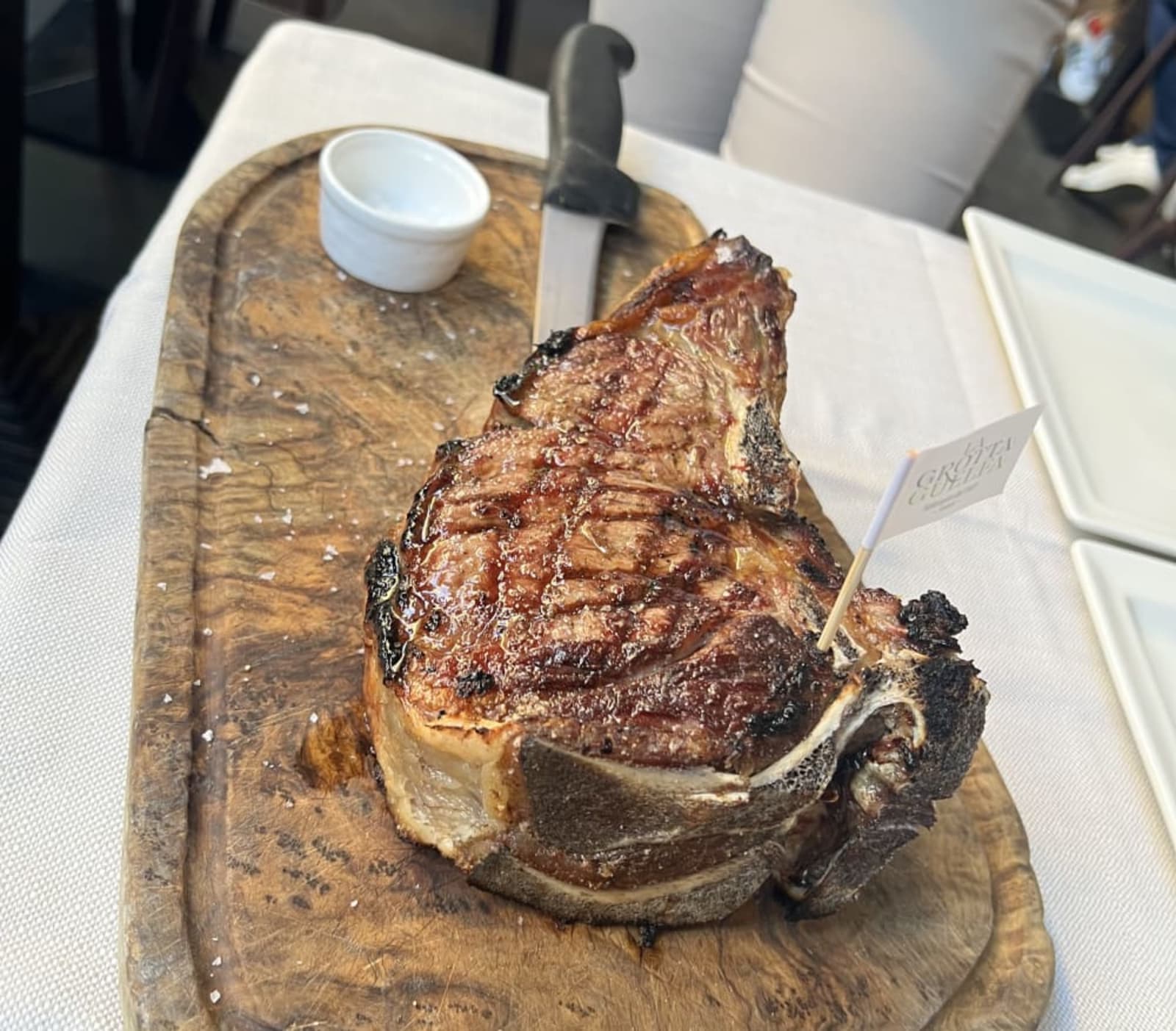
The moment of truth arrived when our waitress wheeled a cart to our outdoor table. There it was: a charred, salt-crusted monolith of beef.
With incredible efficiency, she began to carve. I watched as she neatly separated the fillet and the sirloin from the bone, then sliced them into thick, succulent strips. The inside was a perfect, ruby-red al sangue (rare)—the only way a true Florentine will allow it to be served.
Pairing the meat with a robust Chianti, I realized the steak doesn't need much to shine. Aside from some sprinkles of coarse salt, pepper, and a golden drizzle of olive oil, the flavor of the Chianina beef was the undisputed star of the night.
A Legacy of the "Good Life"
The obsession is so deep that in the 1950s, a publisher named Corrado Tedeschi founded the Italian Nettist Party, better known as the "Steak Party." Their primary campaign promise? A 450-gram steak for every citizen, every single day. While they didn't win the election, it solidified the steak as the ultimate symbol of prosperity and the "good life" in Italy.
Sitting there under the summer sky, sharing a three-pound feast with a new friend, I realized the Medici had the right idea. The art in the Uffizi is breathtaking, certainly—but there is a different kind of masterpiece to be found on a dinner plate in Florence.