The Slumbering Crowd: A Hanoi Morning Ritual
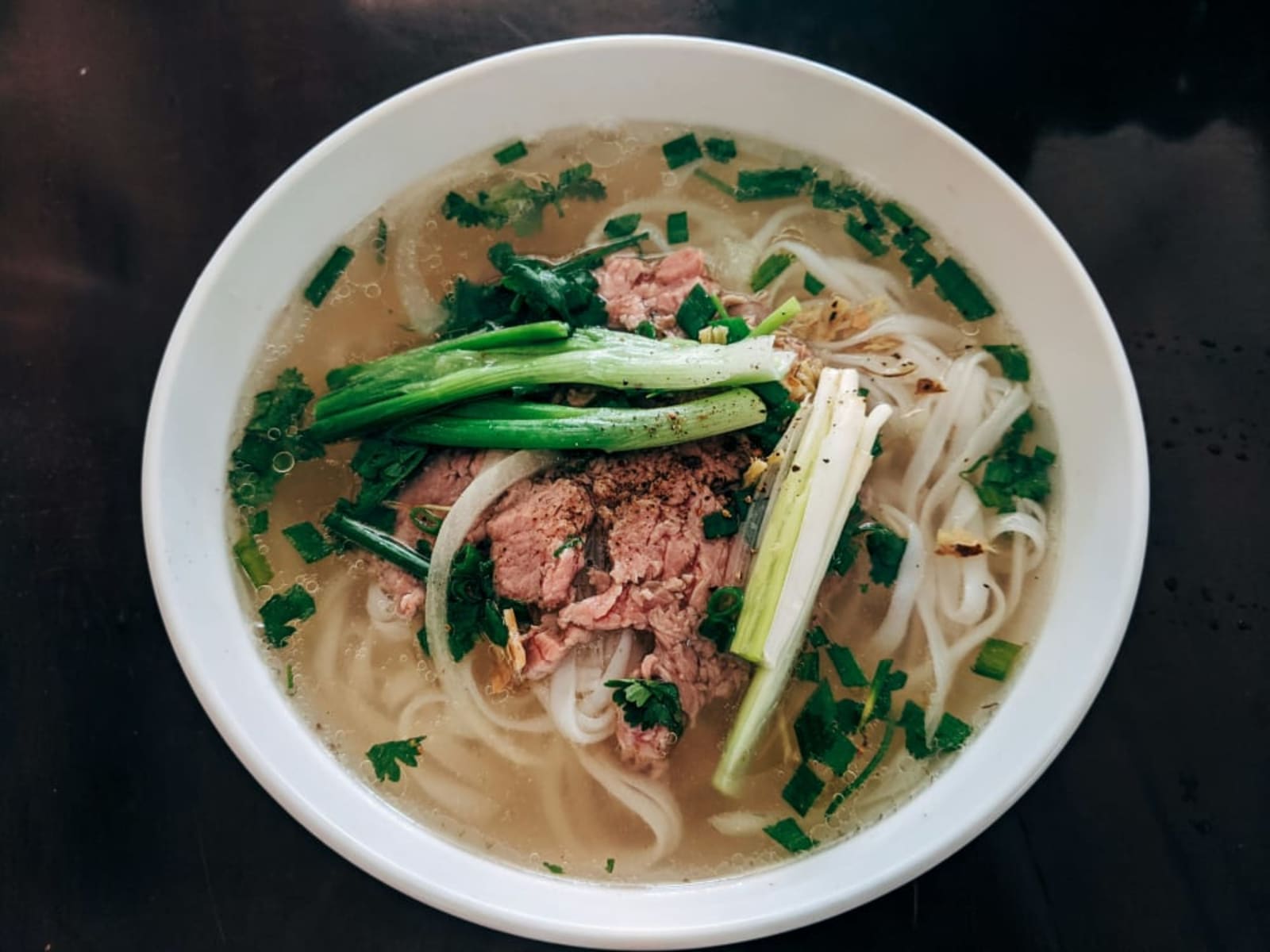
There is a specific kind of magic in the organized chaos of a Hanoi morning. It’s the sound of a Honda scooter engine cutting off, the scrape of tiny plastic stools on a sidewalk, and the steam that rises like a curtain between you and the rest of the world.
For many, Pho is a global superstar, a trendy "health bowl," or a quick lunch. But for those of us born in the heart of Hanoi, Pho isn't a recipe—it’s a memory, a ritual, and a standard of excellence that we rarely dare to replicate at home.
The Beauty in Simplicity (But Make it Hard)
Pho is a masterclass in contradiction. On the surface, it is profoundly simple: rice noodles, broth, meat, and herbs. There are no fancy garnishes, no heavy sauces, and no distractions.
But "simple" is not the same as "easy." To make a bowl of Pho is to engage in a high-stakes game of patience. It’s about the 12-hour simmer of beef bones, the careful charring of ginger and shallots, and the precise moment you skim the surface to ensure the broth remains crystal clear. It is a "professional-only" endeavor. While my mom is a wizard in the kitchen, Pho was never a "home-cooked" meal for us. We left that to the masters who had spent decades perfecting their specific cauldron of liquid gold.
North vs. South: A Tale of Two Bowls
To understand the Hanoi style, you must understand what it isn't.
- Southern Style (Phở Sài Gòn): This is the "extrovert" of Pho. It’s bold, slightly sweeter, and comes with a forest of Thai basil, bean sprouts, and bottles of hoisin and Sriracha. It’s a choose-your-own-adventure bowl.
- Northern Style (Phở Hà Nội): This is the "purist." The focus is entirely on the clarity and depth of the broth. We don't use sprouts. We don't use hoisin. We use a splash of rice vinegar, maybe some fresh chili, and plenty of green onions and cilantro. It’s about tasting the history in the bone marrow.
The Ritual: Four People, One Scooter, and "The Boss"
My most vivid memory of Pho isn't the taste—it’s the commute. Every weekend, my dad would load all four of us—Mom, my sister, him, and me—onto our single Honda scooter. We were a literal "family unit" weaving through the streets.
Our destination? A bustling Phở Gà (chicken pho) shop.
In Hanoi, the best shops don't need menus. The owner usually stands in the center of the storm, a thick stack of cash tucked between their fingers, acting as a conductor for the culinary orchestra. I can still hear the calls echoing over the slurping crowd:
"One brown neck wing! One white skin!"
(In the secret language of Pho Ga, "brown" meant the rich, succulent meat of the thighs and wings, while "white" was for the lean, clean breast meat.)
Sitting on those low stools, shoulder-to-shoulder with strangers in the morning mist, it was impossible not to feel like life was good.
The Beef Evolution: A Connoisseur’s Map
As I grew older, my palate expanded beyond the chicken broth of my childhood. I started reading the legendary Vietnamese writer Nguyễn Tuân, who wrote about Pho with a level of sass and devotion usually reserved for fine wine. Through his lens, I began to see that the beauty of Phở Bò lies in its anatomy. It isn’t just about the meat; it’s about the specific architecture of the cut:
- Tái & Chín: The gateway choices. Thinly sliced rare beef that cooks in the broth versus the comforting, reliable well-done brisket.
- Nạm & Gàu: This is where it gets serious. Nạm (flank) offers a tender, meaty bite with just enough connective tissue, while Gàu (fatty brisket) is the crown jewel for many. In Hanoi, we look for that "crunchy" fat—not greasy, but a firm, flavorful snap that coats the palate.
- Bắp: The shank or heel muscle. It’s lean but deeply flavorful, often sliced thin to reveal a beautiful, marbled map of tendon that provides a slight, satisfying chew.
- Gân: For those who love texture, these are the gelatinous nuggets of tendon that simmer until they are buttery and translucent.
- Vai Giòn: A bit of a "pro-tip" order—this crunchy shoulder cut offers a distinct textural contrast that you won't find in a standard tourist bowl.
- The Specials: From the smoky garlic "wok hei" of Phở Áp Chảo (stir-fried) to the colonial richness of Phở Sốt Vang (red wine stew), the dish proves it can be both a delicate clear broth and a heavy, soul-warming meal.
A Taste of Home, Anywhere
When I moved abroad, Pho changed for me again. It became the "baton" passed between Vietnamese friends. When we couldn't find a shop that matched the Hanoian standards of our youth, we gathered to try and recreate it. It was in those tiny, cramped kitchens that I realized Pho is more than just food—it's a shared language.
Even now, I still leave the heavy lifting to the pros. I don't need to master the 12-hour broth because the memory of it is already bone-deep.
No matter where I find myself in the world, the smell of charred ginger and star anise acts as a compass. I may not be on the back of a Honda scooter in the middle of a bustling Hanoi morning, but for the duration of one bowl, I am exactly where I need to be. The owner is still yelling orders, the plastic stool is still a little too low, and the day is, once again, a good one.